In the afternoon after our ziplining at Selvatura Park, our tour itinerary included an excursion to Cafe Monteverde to see how coffee is grown and roasted in Costa Rica.
On a discount tour, Julie and I have a certain amount of skepticism regarding included excursions that might devolve into an extended shopping trip.
We could have opted out and used that time to explore our Hotel Establo Mountain Hotel's expansive, park-like grounds, but coffee is something we enjoy daily year-round, so why not go to learn more about how it is produced?
After all, included excursions are free. Even when there is a sales pitch and extended shopping time at the end, these excursions usually are mostly interesting to me.
Everyone in our tour group participated in the outing. Our guide at the plantation was a descendent of Quakers who had been part of a large migration of farmers from Alabama and Pennsylvania to Costa Rica in the 1950's. She told us all about how coffee is grown while showing us around the property.
We were encouraged to pick ripe berries for ourselves and experience how difficult it is to determine ripeness and pick the right ones without damaging them.
Nicaraguan seasonal workers provide most of the field labor at Cafe Monteverde and other plantations. The workers are paid by the bag. Based on our rate of picking, we would not earn much beyond the provided room and board during the season.
While we enjoyed pleasant, sunny weather this day, Costa Rica is very close to the Equator, so you know there are some scorching hot days in the field. It's hard work for meager pay, but the Nicaraguans are happy to have the opportunity.
It's a good reminder of how shallow complaints about first world jobs can be.
We learned about the agricultural methods used by Cafe Monteverde to enrich the soil. They don't claim to be organic, saying that is too inefficient.
Frankly, no, but the concepts were interesting and worth learning about.
Eventually, we went to a gift shop that doubled as a tasting room, where our coffee guide served various roasts of coffee and asked if we could recognize subtle differences in taste.
Most who prided themselves on sophisticated coffee palates, boasting about grinding their own beans and their expensive espresso machines or complicated brewing methods seemed to prefer darker roasts, while Julie and I liked the medium roast better.
In response to what I thought a rather silly question about which had higher caffeine, our plantation guide revealed that darker roast coffees are lower in caffeine than lighter roasts. That was the most mind-blowing fact of the coffee tour, one I was relatively sure must be wrong. Upon double-checking it this morning, it turns out that our plantation guide was right!
Yes, drinking that French Roast that to me tastes like someone cleaned an ash tray with the water is lower in caffeine than a nice medium roast like we prefer!
Emphasis was placed throughout the tour on the fact that all of Costa Rica, by national decree, grows only the best Arabica coffee beans in order to become synonymous with quality coffee. Of course, Cafe Monteverde believes theirs is the very best coffee of all.
After the tasting, most of our group began buying souvenirs, including bags of whole coffee beans for gifts or to grind back home for their own complex coffee making methods, whether espresso machine, French Press or what to me seems like a rather absurdly meticulous hand pour method.
At home, we drink pre-ground Don Franisco Vanilla Nut Medium Roast Coffee out of cans, which does not specify Costa Rica or any other particular country as the source of their beans. We use a drip coffee maker, not the cheapest but certainly not the best.
Looking carefully at the label on Don Francisco's coffee can this morning, I am proud to say that they use only 100% Arabica beans. I guess despite the foo-foo vanilla nut twist (which tastes really good with Splenda and milk), our natural taste is for Arabica beans, though not claiming to be exclusively grown in Costa Rica.
However, I will repeat that Costa Rican coffee was excellent throughout our vacation.
That evening, we returned to the lounge for a happy hour sunset.
More of our tour group were there for sunset. The colors weren't quite as spectacular as the prior evening, but the view was still quite lovely.
Julie again had dry, white wine, while I savored a Negroni.
After nightfall, we joined the group for an included dinner at a nearby restaurant in Monteverde.
We remember it being a nicely plated meal with generous helpings of excellent dishes in a lovely restaurant, but the specific details have slipped away.
We dined sharing a table with Steve and Maureen, the couple from Buck's County, Pennsylvania, whom we sat by at our group dinner in La Fortuna. We continued conversations, finding a lot of common ground.
For what it is worth, our tour also included lunch included this day, but I don't recall where or what that was. Life unfolds so quickly that sometimes you have to take notes or you lose track. I usually take pictures as shorthand, but I wasn't as diligent as I should have been.
The next morning, we arose early and went outside to take in the panoramic views once more.
An odd little creature --- a White-Nosed Coati --- scampered by outside our room, a final reminder that we had been staying in a Cloud Forest among wildlife.
Our bus brought us to the lobby at the base of the mountain for breakfast. The restaurant was surprisingly crowded. Still, we enjoyed another wonderful buffet breakfast replete with hot dishes and an eggs-to-order bar, as we had the prior day.
When we were finishing our second meals, a new tour bus from a competitor arrived. The dining room was already close to capacity. A server asked us if we could leave our table, but we weren't quite finished, so we lingered a bit longer.
A few minutes later, but still before our scheduled pickup time, we went to wait for our bus. It wasn't quite a "bum's rush," as my dad used to call it, but it was close, and not a good way to end what had otherwise been an exemplary stay. Rather than sitting by the curb to await our bus, Julie and I went upstairs to a pleasant sitting area.
Soon, we were on the road again, this time heading to Manuel Antonio State Park.
One day as a 6-year-old boy, I walked with Granddaddy through his cornfield.
"Let's tell everyone we saw elephants and lions," I said.
Granddaddy laughed, obviously knowing that no one would believe we had seen those wild beasts walking back from a fishing pond in rural Alabama.
I literally did not know Africa from Alabama.
On TV, Tarzan was the "King of the Jungle" in Africa, which at my eye-level resembled that cornfield, especially because Granddaddy toted a shotgun, just in case.
It was a far cry from the Africa that Julie and I had experienced during our first four days in South Africa. My childhood imaginings of this far away continent did not include sunny beaches, penguins, wine estates and an urban jungle.
Cape Town had exceeded our expectations, but it was time for the next phase of our trip, the part we had most anticipated when we booked it.
"More of the World for Less" translated to rising before dawn the next morning to fly to Johannesburg.
Upon awakening, Julie had immediately asked if I smelled smoke. Once she had mentioned it, I did, but no alarms were sounding, so we assumed correctly that we were not in imminent danger.
On the bus ride to the airport, our tour leader Anni pointed to the source of that air pollution, a fire burning along the side of Table Mountain.
Anni theorized that arsonists had started the blaze in order to be hired to fight it. Basically, an employment program. She didn't specify if she heard this on the news or if it was just some kind of local lore about Cape Town wildfires.
Anni went on to say that with unemployment at 40%, some desperate measures were taken. It was too dark to clearly see the shanties we passed near the airport, but undoubtedly there are some very poor people living on the outskirts of what seems to be a prosperous, first-world city.
At the airport, Anni told us that we would be allowed to take our boxed breakfasts, including liquids, through security, which was rather surprising. By the luck of the draw, my brown bag had weak spots and ripped open, but I managed to keep all of its contents as we headed to the waiting area a couple of hours early for our flight.
It was still too early for breakfast by the time we boarded, so I kept the best elements and trashed the others. Wasteful, but part of the daily breakfast pledge of our packaged land tour.
The flight wasn't particularly noteworthy. I spoke to a guy from our group a bit and then nodded off.
At Johannesburg Airport, we were met by a bus that drove for 2 1/2 hours to drop us to Mabula Game Lodge, our home for the next two nights.
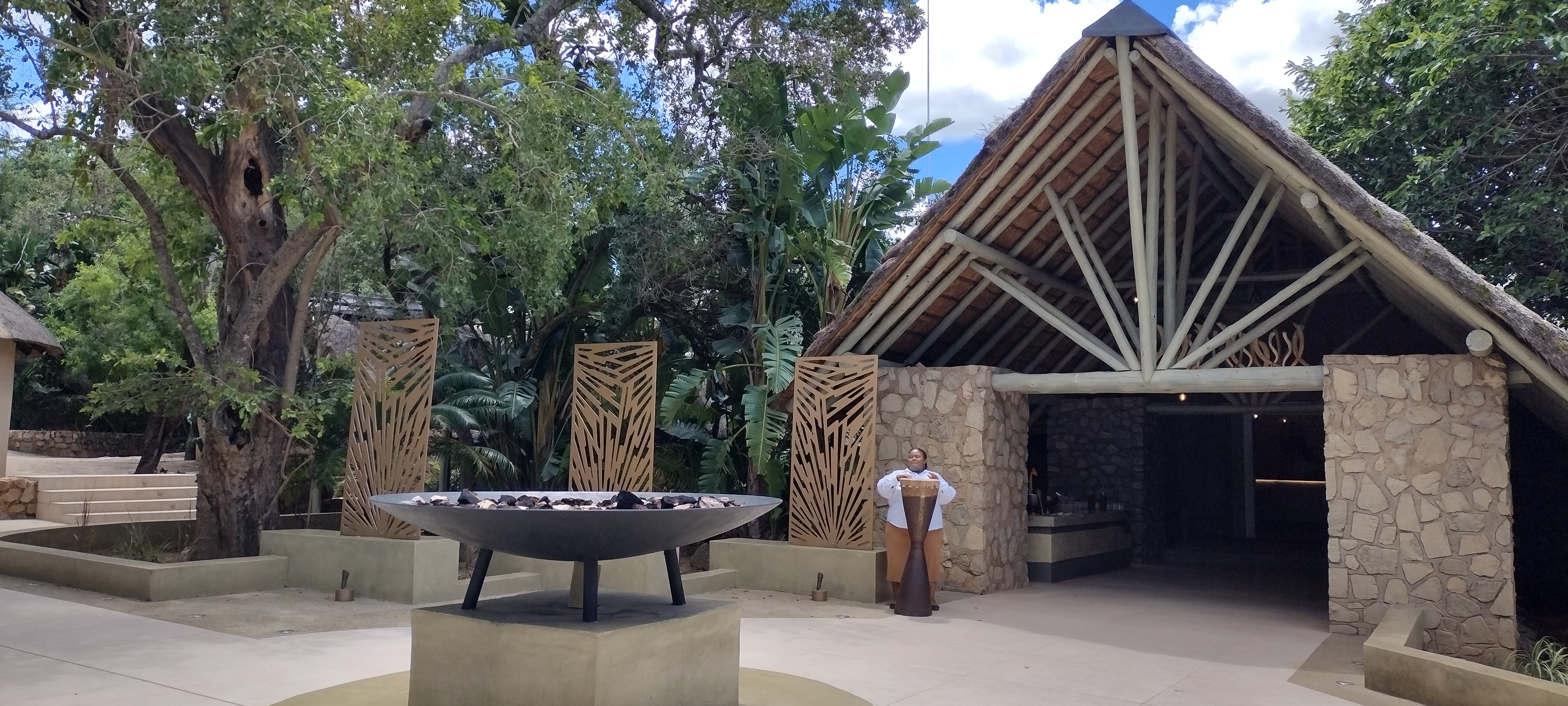
My initial impression of Mabula Game Lodge was that it exactly fit my picture of what an African safari lodge should be.
Perhaps from memories of an old movie?
It was not new, but it obviously had been shown great care.
The large restaurant had a high vaulted ceiling that was the underside of a huge, thatched roof, seemingly contradictory details that worked very harmoniously together to create just the right effect.
Tables, chairs and the serving stations all looked modern and sparkling clean, elements most Americans find preferable for dining.
The buffet had a large selection of choices, including plenty of vegetables, carved meats and a stir fry station for cooked-to-order dishes.
It proved to be an excellent meal. We enjoyed light conversation with our tablemates, though I no longer remember who they were or what we talked about.
Our bungalow was stylistically a smaller version of the restaurant, with a high ceiling and modern accommodations.
The exterior of our unit was less impressive, but we appreciated that wild animals felt comfortable walking around the area.
We occasionally sat with coffee and watched our glass doors on the back of our unit and watched Striped Elands wander past and Rock Hyraxes play on the nearby rock mound.
Rock Hyraxes look a lot like some kind of prairie dog or groundhog, but apparently, they are genetically similar to elephants.
We had time to rest before our afternoon safari drive, so Julie and I donned swimsuits and headed out to the swimming pool.
Preparing for the trip, Julie had spent a lot of time learning about mosquitos in the Limpopo Province, where Mabula is located, but we didn't encounter any, including when we relaxed on lounge chairs by that concrete swimming pond.
South Africa had been part of the British Commonweath for decades, including in World War II when it fought on behalf of the Allies against Nazis in Europe closer to home against Erwin Rommel's Afrika Corps.
As such, it's not surprising that before our game hike, we met for the British tradition of teatime in a beautiful patio area, once again fitting well into my vision of an African safari.
Julie and I were seated separately from the rest of our group. When they all stood up ten minutes before our scheduled departure time, we followed suit.
As we walked out, we were all happy to see wild animals on the lawn outside of the lobby doors.
A group of drivers awaited, and we were soon assigned a guide and vehicle, which remained unchanged throughout our stay.
Our driver/guide would be Vincent, an affable young man with impressive vision who could spot animals I had trouble finding among the bushes even after he pointed them out.
Vincent was extremely knowledgeable about every kind of animal. One of the other travelers asked him where he had trained.
Vincent said he was a Bushman, one of the Khoi-San people indigenous in the region. He learned about animals by growing up among them.
Based on their demeanor, Vincent and all of the other guides obviously love their jobs.
A bit of controversy exploded when we were asked if anyone had any back issues. A few people spoke up, and they were assigned front seats, leading one woman who always seemed to have a complaint to exclaim, "If they have back problems, then they shouldn't have come on this trip."
That led to a quick tongue-lashing by Anni that I think we all felt was quite suitable, especially in light of the fact that this same tourist had been accommodated when she requested rules be stretched for her benefit a few times prior to that.
While I have had back ailments in the past, I didn't have one that day, so I didn't request special accommodation and ended up sitting in the middle of the second row.
Not a bad seat --- there weren't any bad seats --- but I soon determined I would spend most of my time focusing on being in the moment rather than snapping pictures.
It wasn't long before we learned the roads could be rough, and sometimes the rain that had passed through before our arrival made the roads look impassable, but Vincent navigated them well.
I ended up taking more photos than I expected and got some pretty good videos, I think.
Julie captured some good videos, too.
Her youtube followers have been eating up her short videos linked here:
For the first afternoon safari, the goal was to find some less dangerous animals not too far from the lodge, possibly to see if the passengers were too afraid, reckless or physically incapable of going someplace more distant.
At first, we were happy to see some animals in the distance, but soon we were getting up close and personal.
Julie took a lot of photos, most of which are not included, but here are a few from that first day.
Vincent drove to a lake that I must say in my mind's eyed did not look much different from the fishing pond where I used to go with Granddaddy, although I'm pretty sure the childhood version was a lot smaller than it is in my memories.
Vincent pointed out the ears and nose of an otherwise submerged hippopotamus, one of the Big Five.
These beasts weigh over 3,000 pounds and can run 20 miles per hour, so when they are out of the water, they can cause a lot of damage.
Not soon after that, we saw a hornbill, like Zazu in The Lion King.
The guides regularly talked to each other on radios, usually in a language that was probably Afrikaans mixed with a local dialect, telling each other about animals they spotted in different areas in order to bring other drivers there to enhance the wildlife experience for more guests.
We heard a plan in the making, so when we pulled into a small spot, we weren't terribly surprised to see the rest of our group pull up shortly in the other two SUVs in our group.
This would be a favorite part of the afternoon game drives: happy hour in the wilds!
I asked the guides which of the beers was best, and they recommended Carling Black Label, because it is "the Beer of Champions."
They also called it "Soweto Pepsi." It's a good beer.
As the sun set, we still saw more animals on the drive back to the lodge.
A warthog, "Pumba" as we all called him, led us along the trail for a while, a bit more fascinating after our surprise happy hour.
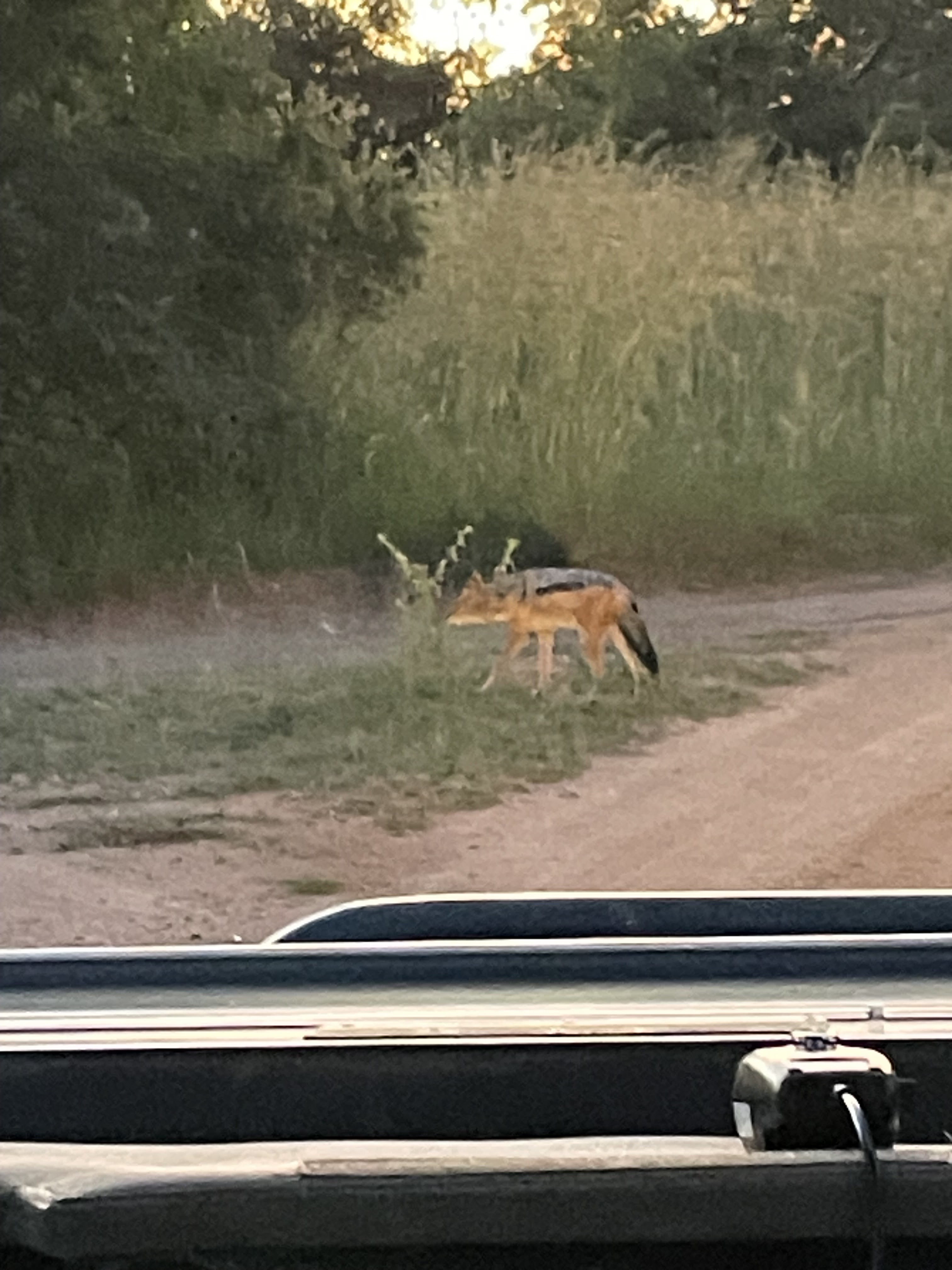
A Black-Backed Jackal also generated quite a buzz in our slightly buzzed group.
Arriving back at Mabula Lodge, it again seemed perfectly aligned with what you might hope an African camp would be like: a bit exotic, upscale and maybe a hint of potential danger.
Dinner would be served at Boma, an open-roofed venue where we dined on diverse local specialties and international cuisine. This dinner was included, as were all of the delicious meals during our time at Mabula.
Beverages were very reasonably priced, so that including tip I think the total bar tab for Julie and me was something like $6.
Anni said later that Gate 1 had negotiated special pricing for our group's drinks at mealtimes.
After dinner, Julie used her iPhone flashlight to illuminate the sporadically lit paths back to our home away from home.
By now, I was relatively adjusted to the big time change and enjoyed a good night's sleep on the firm mattress before being awakened by our 4:30 AM alarm to prepare for the morning game drive.